Terrain® is our service for timely insights on topics and trends impacting agriculture, delivered by a team of specialized economic and agriculture analysts. Additional Terrain articles can be found at TerrainAg.com.
Author: Matt Erickson
Report snapshot
Situation
High construction and financing costs have raised the revenue needed to justify new hog finishing barns.
Finding
The economics may increasingly favor maintaining and reinvesting in productive existing facilities relative to new construction.
Impact
If contract payments are sufficient to keep existing barns operating but insufficient to generate investment in replacement facilities, finishing capacity could gradually tighten as older barns reach the end of their useful lives.
Building construction has become as much a capital allocation decision as a hog-producing decision.
While hog market profitability often centers on feed costs, hog prices, packing capacity, exports and consumer demand, another structural question is becoming important: With rising costs, are today’s finishing payments sufficient to support the next generation of hog buildings?
Rising construction costs, elevated borrowing rates, and stronger competition for capital have increased the revenue required to justify new facilities. As a result, building construction has become as much a capital allocation decision as a hog-producing decision.
Construction costs have fundamentally changed the economics of new buildings
The challenge begins with the cost of constructing a modern hog building. Since the beginning of COVID (February 2020), nearly every major input used in hog building construction has experienced substantial inflation. Iron and steel prices have increased over 83%, electrical equipment costs have risen 70%, fabricated structural metal prices are up 66%, and cement prices have climbed 48%. Even lumber remains more than 37% above pre-pandemic levels, while construction labor costs have increased an additional 26%.
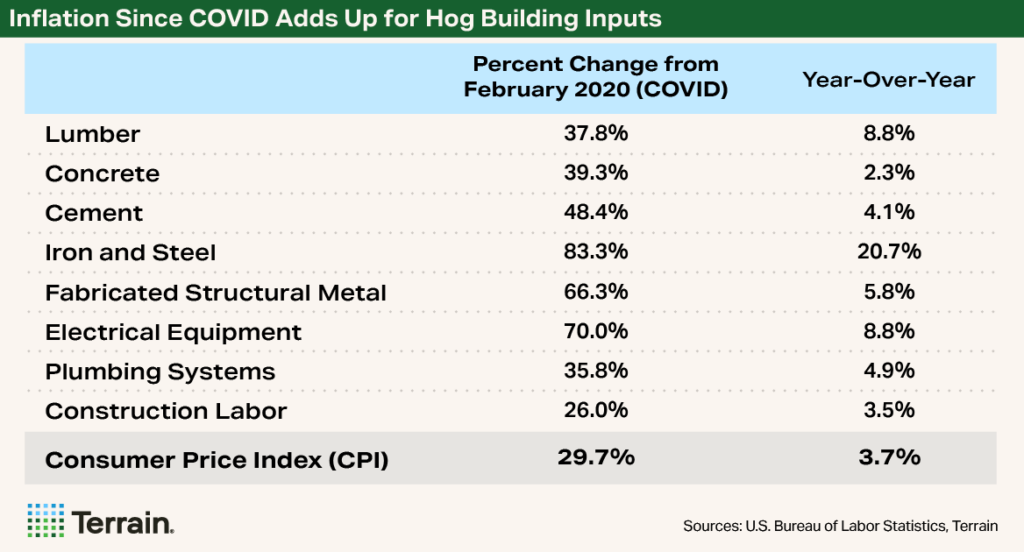
Although inflation has slowed from levels experienced during 2021 and 2022, costs have not returned to pre-pandemic levels. In several categories, inflation remains sticky. Iron and steel, electrical equipment, and lumber continue to post notable year-over-year gains, creating continued pressure on construction budgets.
Trade policy adds a layer of uncertainty. Steel and iron, fabricated structural metal, electrical equipment, wiring, plumbing systems, and ventilation components all have exposure to tariffs through their dependence on globally traded metals and manufactured components. Lumber also remains vulnerable to the long-running U.S.-Canada softwood lumber dispute. Consequently, even if broader inflation moderates, some construction inputs could remain structurally more expensive than producers experienced during the previous decade.
The economics of a new, 3,000-head barn in today’s environment
Consider a 3,000-head finishing facility costing approximately $1.35 million, or about $450 per pig space. Assuming a 25% down payment, financing the remaining 75% at 7.5%, and a 15-year amortization period, annual principal and interest payments require approximately $114,700 in annual revenue, equivalent to over $38 per pig space. Importantly, this estimate excludes any land acquisition costs that may be associated with the project.
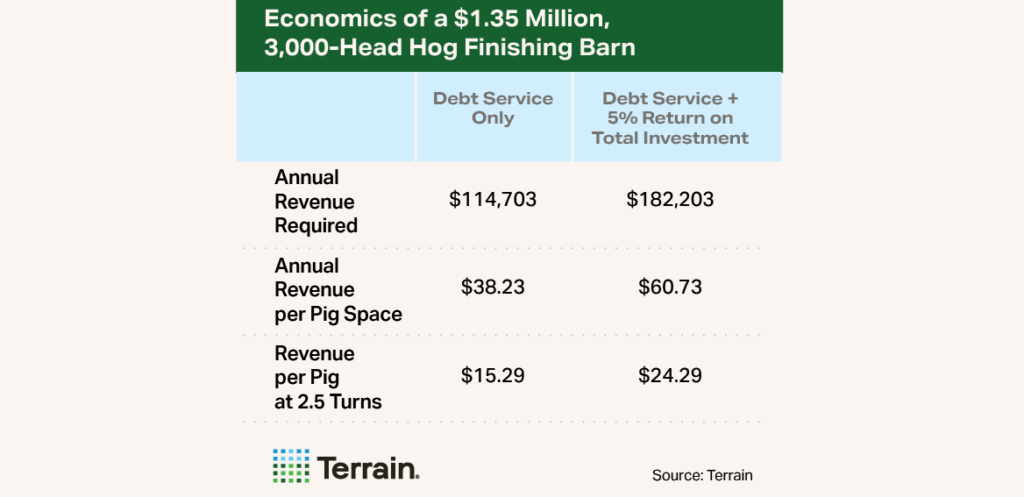
Covering debt service alone does not compensate the producer for management, risk or invested capital. When a modest 5% return on investment is included, the required revenue increases to over $182,000 annually, or approximately $61 per pig space. At 2.5 turns per year, this translates to over $24 per pig marketed before accounting for labor, utilities, repairs, insurance, taxes and maintenance.
New construction decisions, however, are not always evaluated as stand-alone investments. Many producers operate portfolios of facilities built over multiple decades, often including older barns with lower construction costs and little to no remaining debt. In these situations, capital costs can be averaged across the operation, reducing the financial burden placed on a newly constructed facility.
As a result, a new barn may not independently generate a 5% return while the overall business continues to achieve acceptable returns. The investment may also provide strategic benefits through maintaining integrator relationships, supporting succession plans, improving labor efficiency, and preserving production capacity.
This dynamic helps explain why some producers continue investing despite elevated construction costs. For established operators with several paid-down facilities, the ability to add a new barn can differ substantially from those facing a new entrant financing an entire operation at today's construction costs and interest rates.
Construction cost and interest rate sensitivity
The example financing structure reduces annual debt service through a 25% down payment and 15-year amortization. However, it does not eliminate sensitivity to construction costs or interest rates.
The following matrix isolates the annual debt-service requirement across different building costs and interest rate environments. It does not include a return requirement or operating expenses.
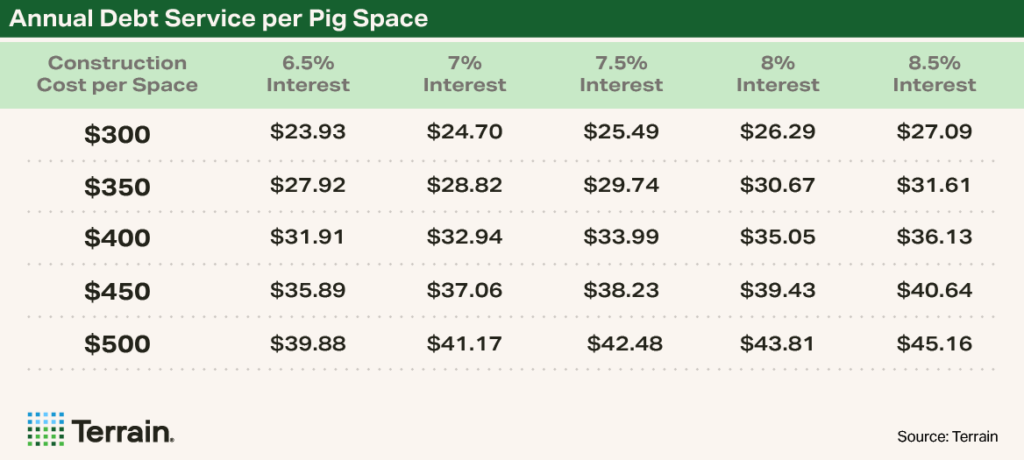
The example building, at $450 per pig space at 7.5% financing, requires approximately $38.23 per space annually for debt service.
The table allows producers to see interest rate and construction cost sensitivity separately. For example:
Lowering the interest rate 100 basis points from 7.5% to 6.5% on a $450 per space barn reduces annual debt service by $2.34 per space.
Lowering construction cost from $450 to $350 per space at 7.5% reduces annual debt service by $8.49 per space.
Moving from a $300 per space barn financed at 6.5% to a $500 per space barn financed at 8.5% increases debt service from $23.93 to $45.16 per space.
A producer waiting for interest rates to decline may still find that a project does not pencil if the underlying cost per space remains elevated.
Lower rates clearly help, but they do not erase the consequences of a higher construction cost base. Under the base financing assumptions (of 25% down, 7.5% interest, and a 15-year amortization), every additional $50 per space of construction cost results in:
$12.50 per space of additional producer equity (or $37,500 for the entire building).
$37.50 per space of additional debt (or $112,500 for the entire building).
Approximately $4.25 per space annually of additional debt service (or $12,750 per year for the entire building).
A producer waiting for interest rates to decline may still find that a project does not pencil if the underlying cost per space remains elevated.
The growing cost divide between existing and new hog finishing space
The economics of contract hog finishing increasingly point to a widening gap between the revenue required to maintain existing finishing capacity and the payment needed to justify construction of new barns. That distinction could become increasingly important as the hog industry evaluates its long-term finishing capacity needs.
FINBIN contract grower data provide a useful benchmark for the economics of existing facilities. From 2021 through 2025, direct and overhead expenses for wean-to-finish contract growers averaged approximately $35.52 per pig space annually, with results remaining relatively stable in a range of roughly $35 to $37 per space. However, covering reported expenses does not fully compensate the owner. FINBIN separately assigns a value to labor and management, which averaged approximately $6.04 per pig space over the same period. Combining direct and overhead expenses with labor and management results in a total economic requirement of approximately $41.56 per space annually.
Average gross margin during the five-year period was approximately $41.77 per space, while average net return after the labor and management charge was only about 20 cents per space. In other words, historical contract payments of roughly $41 to $42 per space were generally sufficient to cover operating expenses and compensate owner labor and management but generated little additional economic profit.
Accordingly, payments in the mid-$30s per space appear broadly consistent with maintaining an existing facility, while payments closer to $41 to $42 per space are more consistent with covering both production costs and owner labor and management.
The economics change considerably when evaluating replacement capacity. Using current construction costs of approximately $450 per pig space, a financing structure consisting of a 25% down payment and 75% debt financing and replacing historical FINBIN capital charges with the economics of a newly constructed facility, the required contract payment rises substantially.
For the new construction analysis, historical FINBIN capital related expenses—including machinery and building depreciation, building lease expense, and interest—were removed to isolate recurring noncapital operating costs. Depreciation is therefore not included as an expense in the 25-year discounted cash flow model. Instead, the capital economics of the new facility are modeled directly through the initial investment, debt financing, required return on producer equity, mid-life capital reinvestment, and residual value at the end of the analysis period. This approach avoids combining historical depreciation and financing costs with the actual capital cash flows of a newly constructed facility.
The model assumes a 25-year economic life for the hog building and incorporates FINBIN derived noncapital operating expenses and labor and management costs. Operating and labor costs are adjusted annually for inflation, while the base analysis assumes a level contract payment with no annual escalator. The model also includes a 15% capital reinvestment in Year 12 and evaluates alternative residual values to reflect uncertainty regarding the facility’s economic value at the end of the projection period. A 5% to 8% equity internal rate of return (IRR) represents the annualized return a producer would earn on their initial down payment, or equity investment, in the facility.
Under a zero residual value assumption, the annual contract payment required to generate a 5% equity IRR is approximately $73 per pig space, increasing to over $76 per space to generate an 8% equity IRR.
Even when assuming the building retains 75% of its original value after 25 years, required contract payments remain high, ranging from approximately $66 per space for a 5% equity IRR to over $72 per space for an 8% equity IRR.
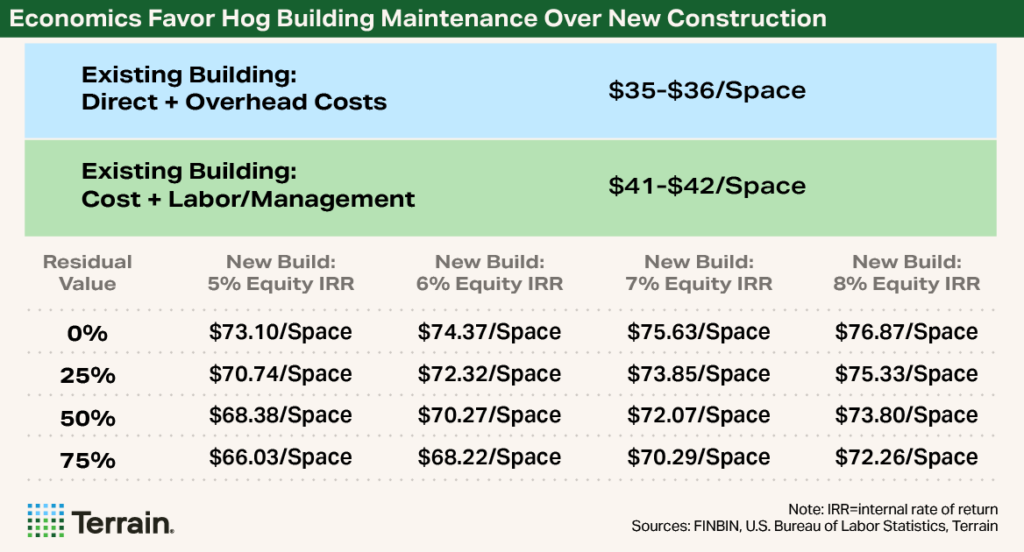
The table highlights a substantial economic gap between maintaining existing finishing capacity and constructing replacement capacity. Historical FINBIN results suggest existing facilities have incurred approximately $35 to $36 per pig space annually in direct and overhead costs, with the economic requirement increasing to approximately $41 to $42 per space when owner labor and management are included.
In contrast, the analysis suggests a newly constructed facility could require approximately $66 to $77 per pig space annually, depending on the producer’s required return on equity and the residual value ultimately retained by the facility.
The analysis intentionally did not include the value of manure availability, as this has different cash flow benefits from farm to farm, but the value driven from manure would help reduce the overall cost per space.
The difference is particularly pronounced under conservative residual value assumptions. With no residual value attributed to the facility after 25 years, the modeled contract requirement ranges from approximately $73 to $77 per space for a 5% to 8% equity IRR—approaching almost twice the historical FINBIN benchmark for an existing facility including labor and management. Assigning greater residual value lowers the required annual payment but does not eliminate the economic gap between existing and replacement capacity.
The central question therefore becomes: What contract payment is necessary to motivate a producer to reinvest equity in a new finishing barn rather than continue operating existing capacity?
Contract payments sufficient to retain today’s capacity may not be sufficient to incentivize the investment needed to replace it.
The analysis suggests that payment is materially higher than the historical revenue requirement of existing facilities. Existing barns benefit from lower embedded construction costs and, in many cases, lower debt burdens, while today’s construction and financing costs create a substantially higher hurdle for replacement investment.
As a result, the economics may increasingly favor maintaining and reinvesting in productive existing facilities relative to new construction. At the same time, existing capacity cannot be maintained indefinitely. As facilities age and eventually require major renovation or replacement, contract payments sufficient to retain today’s capacity may not be sufficient to incentivize the investment needed to replace it. This creates an important distinction between the economic value of existing finishing space and the cost of developing replacement capacity.
Why this matters for the hog industry
The widening gap between the cost of maintaining existing finishing capacity and constructing replacement capacity has implications beyond individual grower returns. Higher replacement costs may favor larger, well-capitalized operations that can spread investment risk across multiple facilities and blend newer barns with older, lower-cost assets.
At the same time, integrators may place greater value on retaining productive existing facilities through longer contract terms, renovation support, or improved renewal provisions when preserving existing capacity is more economical than replacing it.
The implications could eventually extend to pork production itself if construction costs remain elevated and sticky while interest rates remain elevated as the Federal Reserve works to curb inflation. If contract payments are sufficient to keep existing barns operating but insufficient to generate investment in replacement facilities, finishing capacity could gradually tighten as older barns reach the end of their useful lives.
During periods of favorable hog margins, the industry’s ability to expand production could then become increasingly dependent on the availability of finishing space and not necessarily on biological production potential. This would increase the strategic value of well-maintained existing facilities and could make replacement investment an increasingly important consideration in long-term industry growth.
Ultimately, the long-run question for the U.S. hog industry is not simply whether existing finishing barns can remain economically viable. It is whether the economics of contract finishing provide sufficient incentive to replace those facilities as they age out of production.
This analysis suggests the payment required to maintain existing capacity can be materially lower than the payment needed to justify new construction. If that gap persists, it could increasingly influence contract structures, renovation decisions, finishing space values, the pace of industry expansion and vertical integration, and ultimately the long-run productive capacity of the U.S. hog sector.
Planning a barn upgrade, expansion, or new construction project? Learn more about tools and financing solutions designed specifically for pork producers.
Terrain® content is an exclusive offering of AgCountry Farm Credit Services, Farm Credit Services of America, Frontier Farm Credit, and American AgCredit.
While the information contained in this site is accurate to the best of our knowledge, it is presented “as is,” with no guarantee of completeness, accuracy, or timeliness, and without warranty of any kind, express or implied. None of the contents on this site should be considered to constitute investment, legal, accounting, tax, or other advice of any kind. In no event will Terrain or its affiliated Associations and their respective agents and employees be liable to you or anyone else for any decision made or action taken in reliance on the information in this site.