
Terrain® is our service for timely insights on topics and trends impacting agriculture, delivered by a team of specialized economic and agriculture analysts. Additional Terrain articles can be found at TerrainAg.com. Article originally published in the August Issue of the National Cattlemen Magazine.
Author: Don Close
Report snapshot
Situation
The June column highlighted a radical change in the seasonal pattern of the June live cattle futures contract due to feeding cattle longer and heavier live weights. This month’s column evaluates the August live cattle contract.
Finding
At first glance, the August contract appears to be anticlimactic. However, there is evidence that hedgers should be increasingly observant of the market and possibly quicker to respond to short-hedge positions if a pattern of increasing prices develops.
Outlook
The spike in 2025—meaning the August contract expired much higher than its starting price—was driven by the tight supply of cattle. For 2026, I expect the contract to close higher but not as dramatically as 2025’s contract.
In the June article, I showed the radical change in the seasonal pattern of the June live cattle futures contract due to feeding cattle longer and heavier live weights.
This month, I am evaluating the August live cattle contract from the expiration of the June contract to contract expiration. While at first glance, the August contract appears to be anticlimactic, there is some good information for hedgers and market participants.
The June pattern change
Let’s do a quick recap. What forced the pattern change late in the June contract was the additional days on feed needed to get new-crop calves to market weight, keeping fed cattle supplies tight through June. In the old days, a spring-born calf placed on feed in October to November wouldn’t be market-ready until the first half of May of the following year.
Now, with finished weights somewhere north of 1,500 pounds, the quickest a calf can be a merchandisable fed steer or heifer is mid-July. The earliest marketing window now falls between the expiration of the June contract and the expiration of the August contract.
Examining the August contract
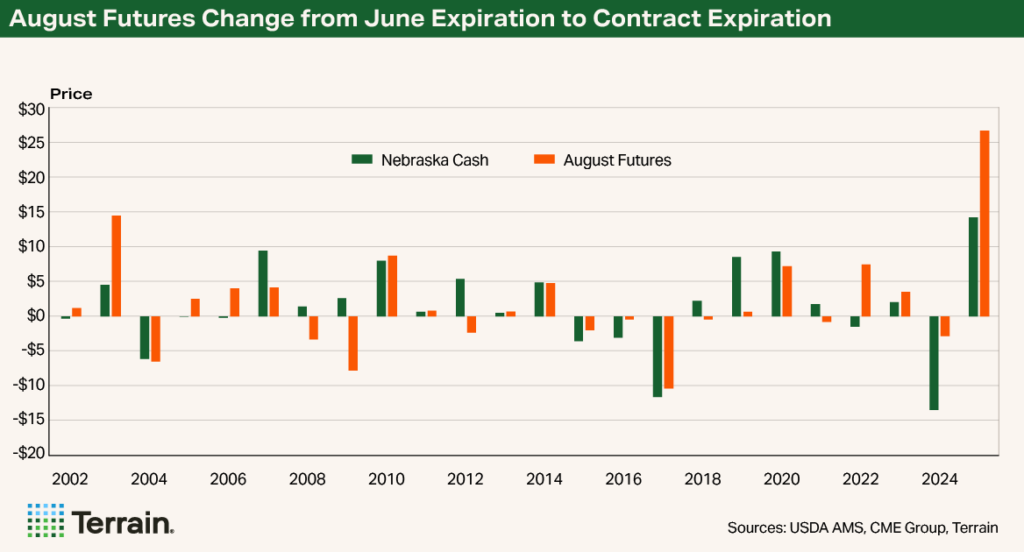
At first glance, there hasn’t been any meaningful change in the price seasonality late in the August contract. The spike in 2025—meaning the August contract expired much higher than its starting price—was driven by the tight supply of cattle. For 2026, I expect the contract to close higher but not as dramatically as 2025’s contract.
A closer examination shows that from 2002 to 2025, the August contract expired higher than where it was trading when it became the spot contract 58% of the time. While 58% doesn’t sound like overly favorable odds, the average price increase during years when the market increased was $6.18/cwt. The average price decline during years when the market declined was $3.69/cwt.
It is worth keeping in mind that the supply of market-ready cattle is more balanced with packers’ seasonal demand during August than in June—maintaining the lower seasonal prices we expect for most of the August contract.
By the end of August, vacation season has ended and families with kids at home are starting to fall into the back-to-school routine. This typically means parents are looking for nutritionally balanced meals with a more rigid mealtime routine. Beef benefits from this seasonal improvement in demand, supporting price recovery.
Also supporting cutout values and the effect on fed cattle prices is retailers and purveyors prepping for the coming holiday season by starting purchases of middle meats.
In a normal seasonal pattern, fed cattle prices begin some level of seasonal price recovery at the end of August, will hold a positive price bias through the fall, and often at least retest the spring price high by late November to early December.
Prepare to respond to short-hedge positions
In my opinion, there is nothing in the expiration of the August contract that should alter a traditional hedging program. There is evidence, however, that hedgers should be increasingly observant of the market and possibly quicker to respond to short-hedge positions if a pattern of increasing prices develops.
We will continue to watch spot contract expiration patterns through the remainder of the year, looking for pattern changes that are the result of feeding cattle additional days to increase weights.
Terrain® content is an exclusive offering of AgCountry Farm Credit Services, Farm Credit Services of America, Frontier Farm Credit, and American AgCredit.
While the information contained in this site is accurate to the best of our knowledge, it is presented “as is,” with no guarantee of completeness, accuracy, or timeliness, and without warranty of any kind, express or implied. None of the contents on this site should be considered to constitute investment, legal, accounting, tax, or other advice of any kind. In no event will Terrain or its affiliated Associations and their respective agents and employees be liable to you or anyone else for any decision made or action taken in reliance on the information in this site.