

Terrain® is our service for timely insights on topics and trends impacting agriculture, delivered by a team of specialized economic and agriculture analysts. Additional Terrain articles can be found at TerrainAg.com. Article originally published in the July Issue of the National Cattlemen Magazine.
Authors: Dave Weaber
Report snapshot
Situation
Higher prices due to the U.S.-Iran conflict have deflated consumer sentiment, but could shifting household budgets impact consumer beef spending?
Finding
Higher wages and impressive job growth suggest that the economy remains resilient despite the uncertain nature of the Iran conflict. Meanwhile, consumer spending on beef remains on a sturdy and improving footing.
Outlook
Recent growth in U.S. jobs numbers and wages appears to be offsetting higher-than-expected inflation and maintaining consumers’ spending at restaurants. Wage growth will have to slow down before spending on beef can slow.
Higher fuel prices have been in the headlines since the conflict between the U.S. and Iran escalated in late February. The higher prices have deflated consumer sentiment, but could shifting household budgets impact consumer beef spending?
As long as wage growth continues, I don’t think so.
A resilient U.S. economy and consumer
Average hourly wages continue to rise, and the U.S. economy continues to add jobs. The most recent Bureau of Labor Statistics data indicate that average wages were up 3.4% year over year in May and that 565,000 jobs were added from March to May. This was about 50% larger than the combined initial reported numbers for March and April and analyst expectations for May.
Combined, higher wages and impressive growth in job numbers suggest that the economy remains resilient despite the uncertain nature of the Iran conflict.
Since the Iran war intensified in late February and early March, the average price of a gallon of gas has risen about 92 cents per gallon versus last year. The average U.S. household drives nearly 300 miles per week. At the U.S. average fleet fuel economy rate of 23 miles per gallon, that adds $55.64 in monthly fuel cost per household.
Certainly, inflation pressures due to rising energy costs aren’t limited to just household transportation costs. Added fuel and energy costs get included in the cost of goods and services from all sectors of the economy.
Terrain analysts expect CPI inflation in May and June to run above 4%, which is likely to be slightly above wage future growth. Tighter real wage growth may force some consumers to cut discretionary spending. But rising home values and record stock market indexes have aided household net worth and retirement incomes and helped buffer the consumer financial picture. Overall consumer spending has remained steady.
Still more beef demand and spending
The National Restaurant Association’s Restaurant Performance Index is a commonly watched bellwether for the food service industry and is highly correlated to job additions or losses and discretionary income. Recent growth in U.S. jobs numbers and wages appear to be offsetting the higher-than-expected inflation and maintaining consumers’ spending at restaurants.
When we look at monthly retail grocery beef spending, we find a strong relationship between the USDA all-fresh retail beef price and average hourly wages. Wage growth so far this year supports our view that retail beef prices will likely continue to rise amid tight beef production levels and strong demand.
The most recently available data we have computed for Real Per Capita Beef Expenditures extend from January through April and show strong year-over-year growth of 10%. The data, adjusted for inflation, represent an 8.3% increase in beef demand. Beef spending during 2026 has been about 20% higher than the previous five-year average for January through April.
Beef claimed a 56% share of retail-valued beef, pork and chicken spending from January to April 2026, gaining 2.8% versus a year earlier and 4.2% versus the previous five-year average.
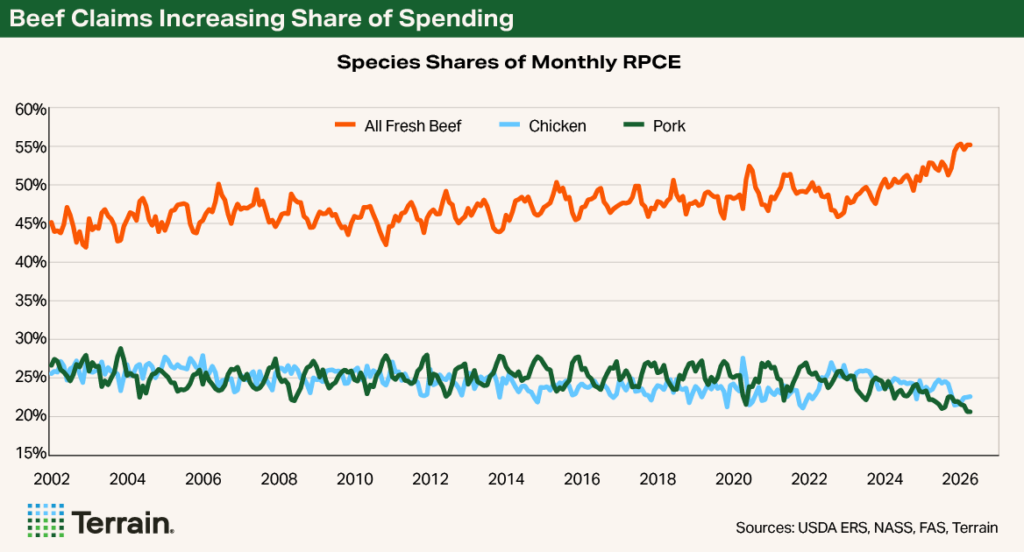
Slower wage growth is necessary for slower beef spending
Consumer spending on beef remains on a sturdy and improving footing, and wage growth will have to slow down before spending on beef can slow. Energy prices and broader inflationary pressures are potential headwinds but have yet to have a measurable impact on beef spending.
I expect inflationary pressures to affect lower income brackets or those living paycheck-to-paycheck first. As these stresses begin to force changes in discretionary spending, we’ll be watching for consumers to trade down within the food service spectrum and simultaneously shift to preparing more meals at home.
Terrain® content is an exclusive offering of AgCountry Farm Credit Services, Farm Credit Services of America, Frontier Farm Credit, and American AgCredit.
While the information contained in this site is accurate to the best of our knowledge, it is presented “as is,” with no guarantee of completeness, accuracy, or timeliness, and without warranty of any kind, express or implied. None of the contents on this site should be considered to constitute investment, legal, accounting, tax, or other advice of any kind. In no event will Terrain or its affiliated Associations and their respective agents and employees be liable to you or anyone else for any decision made or action taken in reliance on the information in this site.


